Karen Romano Young

From the desk: Doodlebug: My Novel in Doodles and Humanimal Doodles, a science comic in print and on the web.
Showing posts with label Humanimal Doodles. Show all posts

Monday, August 22, 2011

Doodling to Learn


I'm always looking for new work, especially these days when I'm stretching to find new ways to work: no longer "just" a writer, in recent years I've become a science writer and an illustrator, and even -- sort of -- a designer, by default, as real (i.e. employed) designers look at my dummy pages with an assurance, or horror, that they're best done by the brain that thunk 'em up.

Sometimes when I'm looking for new work I do up a little marketing thingy for myself, and I was preparing one of these, making it to help scientists better understand what I do when I interview them and turn them into the subjects of blogs or articles or Humanimal Doodles. I needed some pull-out quotes for the marketing thingy, so I asked Beth Lindstrom, the editor of Odyssey, the science magazine in which Humanimal Doodles appear regularly.

Along with saying other friendly things, Beth mentioned that she thought my science comic went along with the principles at work in Felice Frankel's Picturing to Learn project. I hadn't heard of Frankel and her work, so I went to look, and what I found seemed to affirm everything I've been trying to do lately -- from letting go of formal thinking (by this I mean purposeful, goal-oriented, organized thinking), to trusting your mind to take a concept you've been learning about and synthesize a new form -- a visual form -- for it (by this I mean a doodle, and so does Frankel), and to use this doodle as a show-and-tell for what you know as well as what you want to learn, and then to share the whole thing.

This links up with the work I've been doing this summer with my writing and drawing, thanks to Lynda Barry and Writing the Unthinkable (see my last post for links), practicing Lynda's methods for taking yourself out of your formal mind and into the dark waters of the less conscious, disorganized, deep-process part of your head. This is the place I try to take myself to as I write, draw, or design -- and what's coming out of my fingers (yes -- fingers, "the original digital equipment", much more than keyboard) has been different, interesting, and empowering.

Frankel proposes that, through doodling, people learning science target what they know, form it into pictures showing relationships, and set processes in motion. Through her classroom work she has shown that people shown doodles learn more, and has created a program to inspire students to create their own doodles. I'm hoping to learn more about her work.


Saturday, July 16, 2011

Summer Doodling, Summer Not


Who's that girl with the glasses, the fuzzy dog, and the chicken pot pie? It's Marlys, protagonist of Lynda Barry's phenomenal comics.


Has it been nearly a month since I posted? Here are a few of the reasons why:

1. Finished revision of book dummy for a new book about ocean scientists called I Dive to the Bottom of the Ocean (and Come Back to Tell the Tale). My painting hand hurts.

2. Attended Lynda Barry's outstanding writing workshop Writing the Unthinkable at the Omega Institute, which is spectacularly lovely. And Lynda's my idol and guru, particularly for her amazing comics that you can see here. My writing hand hurts.

3. Completed new Humanimal Doodles about lab mice and hagfish. My doodling hand hurts!

How's your doodling hand? If it's not hurting too much, consider designing a Google Doodle -- that's one of those things they have on their opening page which I've written about before here.

Tomorrow, July 17, the San Francisco Museum of Modern Art is hosting a Family Day focused on doodling. Not only can you view the regional winners of the Google Doodle contest, you can try your (non-hurting) hand yourself. For more on this, click here.

Doodle on, dudes! I'm off to vacation, my sketchbook tucked under my arm. Among other art destinations: the Uffizi gallery in Florence... Ciao, belli. I'll be back soon

Monday, June 13, 2011

The Coolest Place I've Ever Worked


Perfect timing: Robin Pulver and Rafe Martin both "shared" Paul Nicklen's amazing Ted Talk on their Facebook pages. In it, photographer Paul Nicklen describes his life growing up in the Arctic, and puts on an astonishing show of his work.

If you've been to the Arctic, the dramatic changes in the sea ice become an immediate and passionate concern, and Nicklen's Ted Talk shows why.

I can hardly believe that it's been a whole year since I set sail about the U.S. Coast Guard Cutter Healy, traveling with a group of scientists who were studying climate change. On June 15, 2010, we left Dutch Harbor, on the island of Unalaska in the Aleutians, and steamed north through the Bering Strait into the Chukchi Sea, crossing into the Arctic Circle. That makes me an honorary polar bear, according to sailors -- but, because I left the ship before the initiation ceremony, I don't have my special red hat.

For two weeks, I was part of this cruise, called ICESCAPE, trailing around behind the scientists as they researched at scores of stations in the open water and a dozen or so on the ice. The Healy is an icebreaker, using its weight and a combination of backing and ramming to make its way through the ice.

Yes, there was ice -- even at the summer solstice. But there was less ice than before, and many signs that the ecosystem that relied on ice was suffering. Tales were shared of walrus and polar bears marooned at sea or on dry land. And, as I tried to process what I was learning, I found myself drawing -- which often happens when I'm struggling emotionally. The result was the first of my Humanimal Doodles, the Walrus Doodle, which I'll reproduce here.

Don Perovich, one of the scientists studying the ice, gave us a visual of the ice situation by comparing the sea ice in 198o to the square footage of the continental 48 United States. Before our cruise last year, the reduced ice coverage in the Arctic amounted to everything east of the Mississippi, plus a lot more. As ice melts, the situation literally snowballs: since water absorbs heat, more open ocean means even more melting ice, and more open ocean... Paul Nicklen reports that the sea ice could break down completely within ten years. Climate change, already well-established, will continue.


Thursday, May 26, 2011

A Look Inside My High School Journal . . . and Beyond!


This collaged notebook represents a watershed moment in my writing life.
Nowadays it's not unusual for teachers to have kids write journals. But in 1977, when I took three English classes at once and two of them required journals, it was very new. (I'm hoping one of my teachers will comment on this post and say what the thinking was.) I was a high school senior with a scary scientific paper term project (another assignment that had a major impact on my future writing and interests), trigonometry to survive, and lots of other senior-type things to do, so I asked the two teachers to let me write one journal that they both could read and grade.
I wasn't worried about the journal writing, just didn't want to have to write two journals. I had kept a diary since I was nine, and was a regular journaler. Sometimes I shared sentences or paragraphs of what I'd written with my aunt (just a year older than me), who also journaled. But this was the first time I'd ever written something that I knew for certain would be read by somebody else.

Mainly the journals were read for quantity; we had to write a certain number of entries, and one of the teachers (not the one I hope will comment) really seemed to just check it off. But under the eyes of the other teacher, Fran Kondziela, my writing bloomed and took off. A theater director as well as an English teacher, she was quick to point out that I needed an audience. Now, isn't that an interesting thing to find out about yourself? It makes sense, I guess. Like many who aren't physically confident, loathe getting up on a stage, and have palpitations about public speaking, I became a writer because I needed to express myself. Who was reading? Nobody -- until Ms. K.


My journal, Ms. K's comment

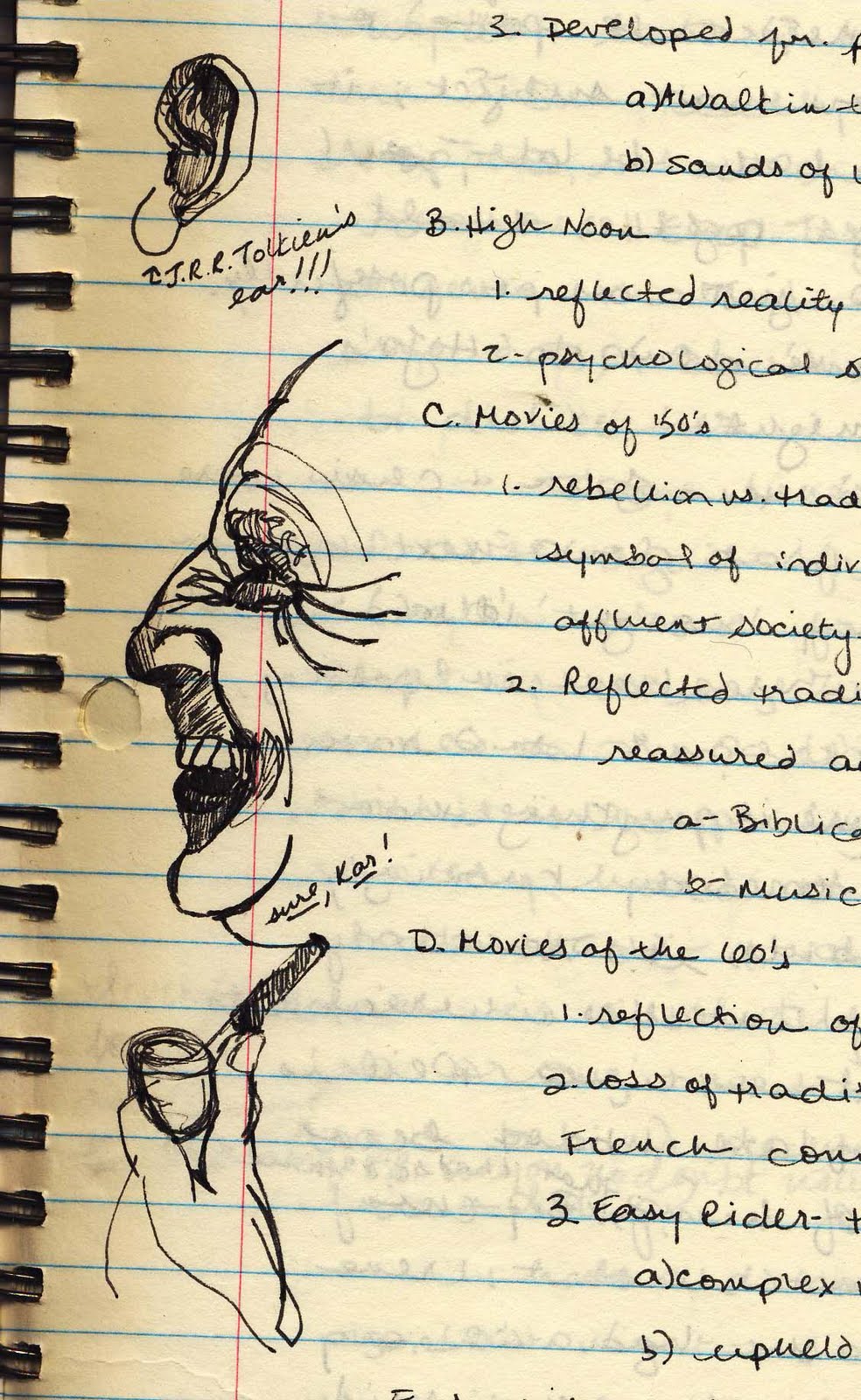
And that wasn't all: my writing improved when I had feedback, not just approval, from someone else. Ms. K. posed questions and made comments in my margins, and that led me to better, clearer, more thoughtful writing. Looking back at it, I also notice that I was forever drawing and doodling. Here's one example, J.R.R. Tolkien, from the back of my copy of The Two Towers.


Doodle: Tolkien and his ear

As ever, journaling has enormous value for me as a writer and as a human. It's fun and funny and educational to look back on the things I was worried about when I was 17, or 32, or 47. It helps me to see straight into those days as if I had a telescope taking the long view back into the dots on my personal timeline. So much is there, from the music I was listening to (and going to concerts of such as, in 1977, Eric Carmen, Loggins and Messina, and Peter Frampton).


I don't share my journal entries anymore, preferring to keep them private. But the journal begun for high school English in the spring of '77 taught me the value of working with a trusted reader or writing partner, someone who would confirm what was good and question what was questionable.

Nowadays I rely on the response of other writers, artists, editors, my agent, and my children.
For several years, I worked with a novels-only writing group that devoted hours and hours to each other's work -- and from which some truly beautiful novels emerged, and continue to emerge even though we have disbanded.

Without the responses of my daughter Emily and author/illustrator friend Katie Davis, Doodlebug would never have come to be, and writer/editor Ann Downer provides invaluable input about my Humanimal Doodles.

I've got to get to work, I really do. I've got a new writing partner, Gail Carson Levine, and she's expecting a new installment of the semi-graphic novel I'm working on. I'm inspired by the masterful revisions Gail has been doing on her own novel chapters, and reminded once again how important it is to have an audience that listens well, makes comments, and tries to follow my sketchy plots.

Sometimes it's difficult. Every time Gail and I meet she asks me a question that causes me to drop my head right onto the table in dismay -- something I'd blanked on, not thought of, done wrong, not considered. It's not easy, this writing job! But then I think of a possible answer, and Gail shakes her head, I think of another and Gail tilts her head to one side, considering. We talk about it a while. And then I get back to work.

Counting my blessings here, I'm very grateful. And that includes Peter Frampton.


Sunday, May 15, 2011

Electrifying News About Humanimal Doodles


It's a rainy Sunday here at the Doodling Desk -- all the more reason to share the sunny, newest Humanimal Doodle in print, the Vespa Doodle. As with all my Humanimal Doodles, this one, just published in Odyssey magazine's May issue, covers news about what people are learning from animals -- in this case Vespa orientalis (that's its page at the Encyclopedia of Life, where eventually every known species will have its own page). Vespa orientalis is the Oriental hornet (or wasp). Scientists have discovered that its body acts as a little solar cell, turning sunshine into electricity.

But you know me: just say the name of a wheeled vehicle and I'm likely to drop it into whatever I'm writing or drawing. So of course when I realized that the source of the name for those nifty little motor scooters you see in European cities (and once in a while in New York or Boston or Bethel, Connecticut) was the Latin word for wasp, I jumped right on it -- on the doodling, of course, not the Vespa, alas. (I'd like a robin's egg blue one, although the orange one in that link is sweet.) I plopped a scooter right into the doodle. For me, that's part of the fun of doodling for me -- the freedom to free-associate in pictures.

I've been doing these Humanimal Doodles for almost a year now, since posting the Walrus Doodle during a trip to the Arctic Ocean. They've appeared in print and on the web (as on the World Wildlife Fund site in that Walrus Doodle link.) The Vespa Doodle is the sixth one that has appeared in Odyssey. In the works: doodles about mitten crabs, Alvin the submarine, and laboratory mice.

Here's the Vespa Doodle:

Wednesday, May 11, 2011

Come On In!

From my desk in the window of my little house in the woods, I can see the pine tree in the front yard, which has a door nestled among the roots. My mother gave this door to me. This is typical, because she's the one who taught me to be whimsical, to anthropomorphize, to envision that door opening on a pine-scented spiral stairway that leads up the tree to the doodling workshop where I might sit, pen in hand, drawing stories, doodling pictures, writing text by hand, making up my own fonts.

Like the door to the pine tree, doodles may seem to be whimsical, unrealistic, the product of an overactive imagination. But, in the year since I began publishing them, I've realized the power of doodles.

I get doodle power from children who attend my doodling workshops -- such as the ones I did for the GRLS program in Boston last weekend -- who try out the black finepoint and gray brushpoint pens I give them, drawing constantly, telling their stories, lifting their heads only in curiosity about the pictures I'm creating as I tell them my own stories.

I get doodle power from the parents who tell me that my novel Doodlebug has gotten their kids reading at last, or that learning about my doodling has encouraged them in creating their own graphic stories.

I get doodle power from the teachers who tell me that my Humanimal Doodles have gotten their students talking about science - or arguing about, looking into, or trying their own science.

I get doodle power from the scientists who like how their stories are told, who comments and make suggestions and ask for more.

I get doodle power from the grownups who learned to read by reading comic books, and the librarians who recognize that any reading is good reading and the kids who realize that good reading doesn't have to be all typeset words.

I get doodle power from finding out how many other people -- just about all other people! -- doodle, and I love learning what they draw and why.

And this week I'm getting doodle power from National Doodle Day, tomorrow, May 12.  Neurofibramatosis, Inc., sponsors this celebration.  During their events this summer, they'll be giving away ten signed copies of Doodlebug: A Novel in Doodles. For more about this, please click here.  

In this blog, I'll talk about some of my travels and experiences associated with creating and getting the word out about my doodles. And I'll talk about what's going on behind the workshop door, on the doodling desk.